95:5: Why brand building matters
I’ve been thinking a lot about measurement in marketing again (when aren’t I?!) Specifically the relationship between spend and results. In the race for growth, many companies pour budget into performance marketing—buying digital ads for quick wins – only to hit a plateau. It got me thinking: Is an ads-only strategy sustainable in the long term, or is there a guaranteed point where a business needs to pivot to brand-led marketing? Anecdotally, all the biggest brands in the world are brands, if that makes sense. I don’t know of too many billion-dollar companies we don’t know about or who sustain their marketing issues on ads alone. It feels that there’s always an inflexion point where brands need to switch from a pure ad-based approach to building a fully sustainable brand-led marketing approach. But let’s dig into this.
The quick fire round
You’ll find all the links at the bottom, so you don’t think I’m among the 83.25% of people who make up statistics.
A ‘pure’ ad strategy probably isn’t sustainable:
Studies show customer acquisition costs have surged dramatically in the past decade. One analysis found that the average Customer Acquisition Costs (CAC) jumped 222% between 2013 and 2022.
In 2022, ASOS’s CEO admitted that over-investment in short-term performance marketing undermined sustainable growth (i.e. brand building).
Ad blockers have skyrocketed from about 44 million users in 2012 to over 900 million in 2023 (over 20× growth). 2 in 5 internet users now use ad-blocking software.
86% of consumers exhibit banner blindness – they pay zero attention to banner ads or anything that looks like a promotion. This is reflected in abysmally low engagement rates. The average click-through rate (CTR) for display ads is well below 1%, often around 0.3–0.6%. In other words, 99%+ of banner ads generate no direct response.
In another poll, 70% of Americans said they are annoyed by pop-up ads, and 82% have closed a webpage because of an autoplay video ad.
On the flip side, most companies get to the point where they understand the need to switch to brand marketing:
95% of B2B buyers say that when they are ready to purchase, they choose a brand they recognise. In consumer markets, Nielsen finds that 59% of consumers prefer to buy new products from brands they know over unfamiliar brands.
When Airbnb shifted its focus away from search ads to brand marketing, it discovered that over 90% of its web traffic was coming organically.
One study found emotionally resonant ads increased a brand’s pricing power by 40%.
Why am I banging on about this? One, I have a predilection for not wasting money in marketing, and it led me to the 95:5 rule, which I think is an interesting concept to understand when it comes to brand-led marketing, and all of these stats will suddenly start making sense.
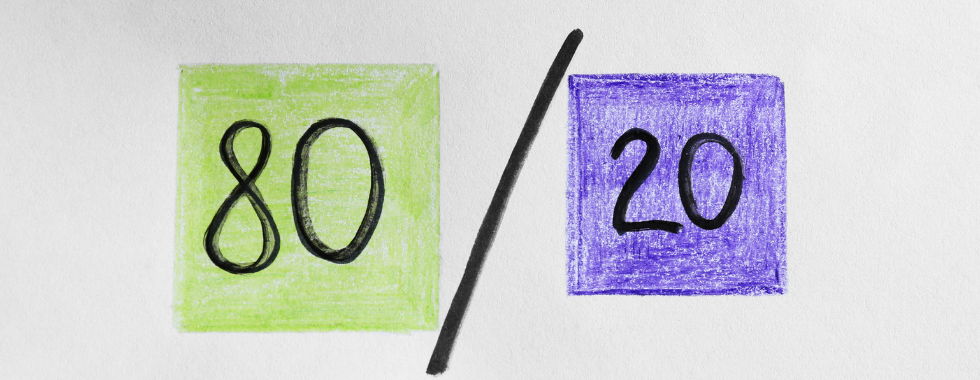
80/20 is a bit outdated, apparently
If you’re involved in marketing, you were probably introduced to the Pareto Principle or the 80/20 rule fairly early on, and I’ve always looked at it as a mantra for most marketing efforts. It purports that 80% of outcomes will come from 20% of causes. So, 80% of your sales will come from 20% of your customers, and 80% of your productivity will come from 20% of your employees. I could go on, but you get the picture. However, there are some new, bigger, better numbers in town: the 95:5 Rule.
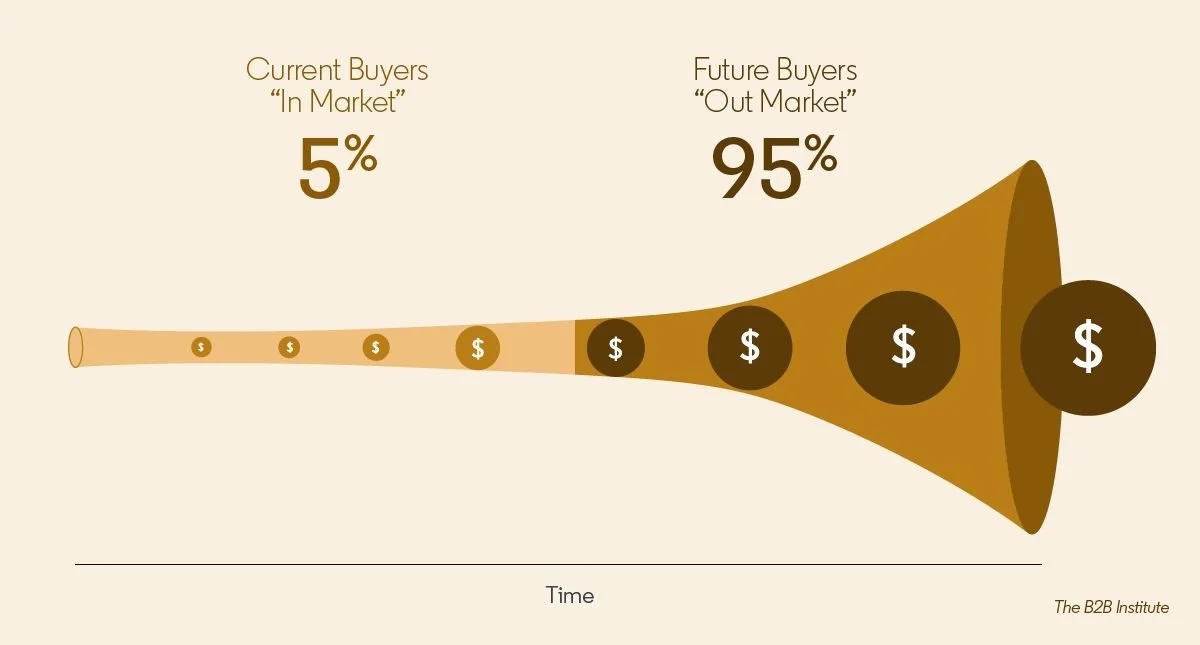
Simply put, the 95:5 Rule, popularised by Professor John Dawes from the Ehrenberg-Bass Institute, suggests that at any given moment, only about 5% of your potential customers are actively looking to buy what you’re selling. Sounds low, right? Some people define it as a 70:20:8:2 rule. But that was just too complicated to mean anything, so I ignored it and stuck with this idea that 95% of people who see anything about you just aren’t interested in it (at that specific point in time).
Reading this blew my mind, but instinctively, I thought, ‘There’s something in this’ while also thinking, ‘That seems a bit far-fetched’. Marketing can often be an enigma.
The other 95% aren’t on the market right now—they might be tomorrow, next month, or even next year, but today, they’re not ready. This insight, while straightforward, has big implications for how you approach marketing.
Why does the 95:5 rule matter?
Too often, marketing strategies obsess over immediate sales. It makes sense—results today are measurable and feel rewarding. But if 95% of your audience isn’t ready to buy right now, focusing solely on immediate conversions can mean missing out on a huge amount of future opportunities.
Research is there to back this up. Dawes found that businesses typically switch major providers (like banks or law firms) about once every five years. Only around 5% of companies are actively looking for new providers in any given quarter. Your job isn’t just selling to that small segment now; it’s also building a relationship with the other 95% who will eventually need what you offer at some undetermined time in the future.
The power of long-term thinking
Leading marketers like Les Binet and Peter Field emphasise that long-term brand-building efforts drive more sustainable growth than short-term sales activations alone. They famously recommend around a 60/40 split for brand versus activation campaigns. For B2B marketers, where buying cycles are longer, this focus on the brand might even need to be more pronounced.
This perspective isn’t limited to theory. Consider companies like Salesforce or Hubspot, both B2B businesses. Their marketing emphasises brand-building and keeping their name top-of-mind even among customers who aren’t immediately shopping for CRM software. By continuously engaging their audience, they ensure they’re the first choice when customers eventually move into the buying phase.
Balancing short-term gains and long-term wins
Of course, this doesn’t mean ignoring immediate opportunities. You still need strategies to capture the 5% actively looking to buy. The key is balance. Of course you need to allocate part of your budget to quick-win tactics like targeted ads and lead generation. I’ve seen what happens when you turn these efforts off, and it’s not a good idea, especially in the digital ecosystem of brand-building/ads (I’d hate to say that Google doesn’t like people brand building and NOT buying ads at the same time, but it may). However, recognising the value in consistently investing in brand visibility, thought leadership, and relationship-building content that speaks to future buyers is becoming more and more important.
I’ve recently been speaking to companies about AI marketing, and the concept of zero-click has come up A LOT (but that’s for a different article). Visibility on what people are or aren’t seeing about your brand is becoming more commonplace, meaning you need to think about your brand’s presence, even where you can’t see it.
Practical steps to apply the 95:5 rule
Invest in Brand Awareness: Keep your brand visible and memorable even during slow periods. Consistent, year-round marketing ensures you’re top-of-mind when customers do become ready to buy.
Always-On Marketing: Instead of short, isolated campaigns, maintain an ongoing presence. Regular visibility builds familiarity and trust. (Just another fun fact: people need to see an ad five to seven times before processing it! Google ‘The Rule of 7’.)
Content for Every Stage: Create valuable content that engages customers who aren’t ready yet. Educational resources, thought leadership articles and insightful reports keep your audience engaged until they are.
Measure Beyond Immediate Sales: Track long-term metrics like brand recall, share of voice, and customer engagement. These indicators often predict future market share better than immediate conversions alone.
Personalise Your Approach: Distinguish messaging for those currently shopping versus those not. Offer detailed product insights to in-market buyers while providing broader value and education to the rest.
The bottom line
Adopting the 95:5 Rule means recognising marketing as a long game. Brands that thrive aren’t just those that capitalise on immediate opportunities; they nurture future demand through sustained brand-building efforts. By investing today in becoming memorable and trusted, you’ll position your brand as the go-to choice when your audience inevitably moves into buying mode.
In short, successful marketing isn’t just about selling today—it’s about preparing to sell tomorrow, too.
Here are the links I promised you:
https://www.cybba.com/blog/how-to-beat-banner-blindness
https://www.ncsolutions.com/insights/long-term-sales-effects/
https://www.spiralytics.com/blog/emotional-marketing-statistics/
https://www.nielsen.com/insights/2015/looking-to-achieve-new-product-success-listen-to-your-consumer/
https://hbr.org/2015/11/the-new-science-of-customer-emotions
https://www.b2binternational.com/publications/emotions-in-b2b-decision-making/
https://ipa.co.uk/news/ipa-publishes-new-brand-and-activation-research-the-long-and-the-short-of-it-balancing-short-and-long-term-marketing-strategies
https://explodingtopics.com/blog/ad-blocker-stats
https://www.marketingweek.com/strong-brands-profit-pricing-power/
https://www.gartner.com/en/sales/insights/b2b-buying-journey